
The Art and Science of Silogism
Silogism is an essential concept in logic that plays a crucial role in reasoning and argumentation. This article examines the foundations of silogism, exploring its historical significance and contemporary applications. By understanding its structure and function, readers can enhance their critical thinking and analytical skills. Discover how silogism underlies many logical deductions and how it continues to influence modern thought processes.
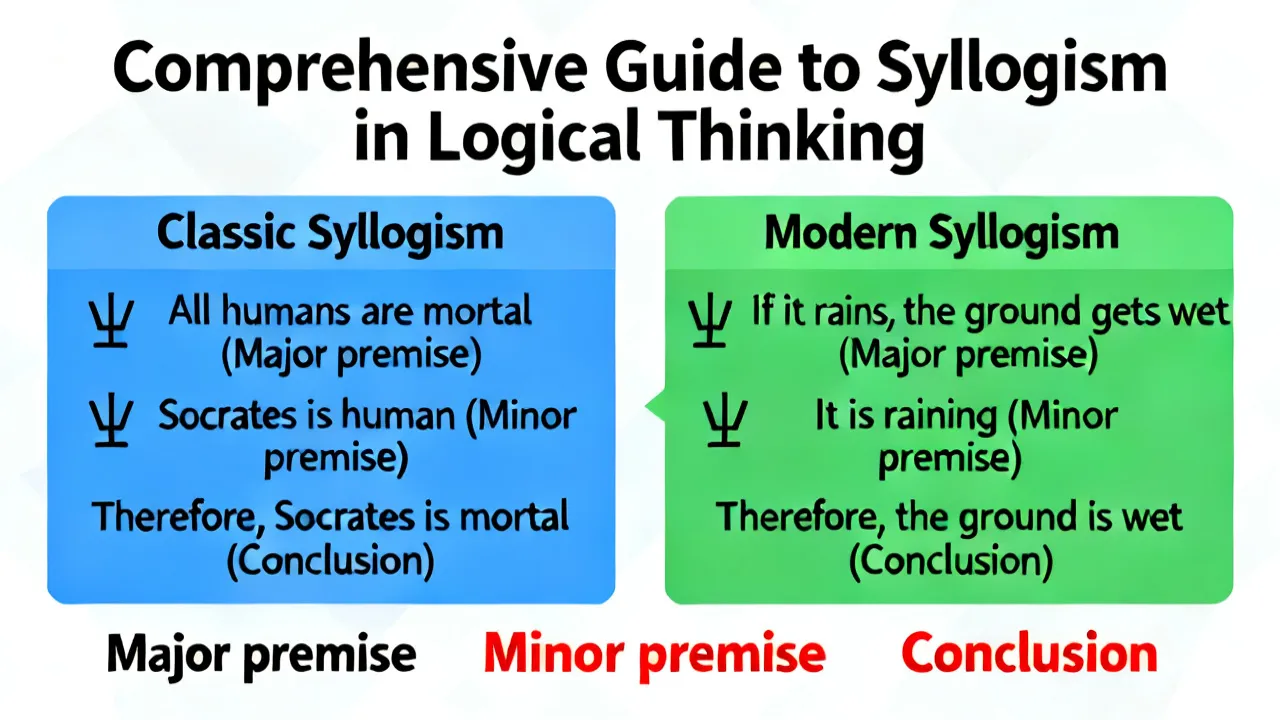
Understanding Silogism: An Overview
At its core, silogism is a logical argument that applies deductive reasoning to arrive at a conclusion based on two or more propositions. These propositions are assumed to be true, and from them, a conclusion is drawn. The very famous example of a silogism is perhaps, "All men are mortal. Socrates is a man. Therefore, Socrates is mortal." This demonstrates the fundamental structure of silogism: a major premise, a minor premise, and a conclusion.
To delve deeper into the concept, it's important to recognize that silogisms are not just tools for academic debate but foundational frameworks that dictate logical reasoning in various contexts. Understanding how these arguments function helps individuals across fields—from science to philosophy—navigate complex ideas and concepts, drawing valid conclusions from established facts.
The Historical Roots of Silogism
The concept of silogism can be traced back to ancient Greece, with the philosopher Aristotle being credited with its formulation in his work, "Prior Analytics." Aristotle's silogisms formed the foundation of classical logic, influencing subsequent philosophical, mathematical, and scientific thought. The study of these logical arguments was a significant aspect of the curriculum in medieval universities and laid the groundwork for modern logical theories. Aristotle's work distinguished between different kinds of syllogisms and emphasized the significance of valid reasoning in constructing arguments.
Furthermore, the evolution of silogism through various philosophical schools demonstrates its enduring relevance. While Aristotle's formulations provided a robust foundation, subsequent thinkers, such as the Stoics and the Scholastics, expanded upon his ideas. They explored the implications of logical relationships and how they apply to various aspects of human experience and understanding. For instance, medieval scholars meticulously applied Aristotelian logic to theological debates, a practice that further solidified silogism's role in rational discourse.
As we moved into the Renaissance and Enlightenment periods, the critical examination of silogistic reasoning took center stage. Philosophers like René Descartes and Immanuel Kant questioned the premises and frameworks of logical arguments, advocating for a more nuanced approach to reasoning that considered human perception and the complexities of the human condition. This critical analysis laid the groundwork for modern logic and the diverse branches of inquiry that followed, such as symbolic logic and mathematical logic.
Types of Silogism
Silogisms can be classified into several types based on their structure and the nature of their premises:
- Categorical Silogism: This type involves statements that assert or deny something about a particular category. Each premise ties a subject to a predicate, leading to a logical conclusion. Categorical silogisms are often used in everyday reasoning, especially in discussions that categorize objects or people, such as defining roles or characteristics.
- Conditional Silogism: Conditional silogisms work on "if...then" logic. They involve premises that establish conditions for a particular outcome. This type of argument is particularly useful in scenarios where outcomes are contingent upon specific circumstances, allowing for a structured way of discussing cause and effect, decision-making processes, and predictions.
- Disjunctive Silogism: These involve a choice between two possibilities, structured as "Either...or" statements. Disjunctive reasoning is crucial in analyzing alternatives and making choices based on limited options, often applicable in philosophical, legal, and logical challenges where binary decisions are required.
- Hypothetical Silogism: These are complex arguments that involve multiple interconnected conditional statements. This type of reasoning allows for a more intricate exploration of possibilities, emphasizing logical relations between various propositions. Hypothetical silogisms are often utilized in mathematical proofs, theoretical science, and advanced philosophical discussions.
Understanding these types, along with their structural nuances, can greatly enhance one's capacity to construct and analyze arguments, leading to clearer and more persuasive communication.
Silogism in Modern Context
In contemporary times, silogism is not confined to academic philosophy or logic studies. It holds significant value in fields such as computer science, artificial intelligence, law, and rhetoric. For example, in programming, reasoning based on conditional logic – a form of silogism – is fundamental for decision-making processes. Programming languages often incorporate conditional statements, enabling the development of algorithms that emulate logical reasoning.
In legal settings, silogistic reasoning helps in constructing sound arguments based on established principles and evidence. Lawyers frequently rely on logical structures to develop their cases, evaluating various premises to reach a valid conclusion. The ability to articulate arguments through silogistic reasoning enhances advocacy and contributes to more effective judicial processes.
Moreover, fields like artificial intelligence use silogistic logic to create reasoning systems that can analyze data, draw conclusions, and learn from complex scenarios. Machine learning algorithms, for instance, often incorporate logical frameworks to identify patterns and respond to varying inputs, thus reflecting a modern adaptation of ancient reasoning. As AI becomes increasingly integrated into our daily lives, understanding the foundational structures of logic aids both developers and users in harnessing its potentials responsibly and effectively.
| Type of Silogism | Description | Example |
|---|---|---|
| Categorical | Links categories using premises to draw a conclusion. | All birds are animals. All swans are birds. Therefore, all swans are animals. |
| Conditional | Uses “if...then” relationships to infer outcomes. | If it rains, the ground will be wet. It is raining. Therefore, the ground is wet. |
| Disjunctive | Offers alternatives with an “either...or” choice. | Either the light is on or off. The light is not on. Therefore, the light is off. |
| Hypothetical | Combines multiple conditional statements for a conclusion. | If A then B; if B then C; therefore, if A then C. |
Designing Effective Silogisms
Creating a valid and sound silogism requires careful consideration of the premises and their logical consistency. A silogism is only as good as its premises; therefore, ensuring their truthfulness is crucial. When crafting arguments, it's essential to avoid common fallacies such as affirming the consequent or denying the antecedent, which can undermine the strength of the conclusion. Recognizing these logical fallacies aids in sharpening one's analytical skills and fosters stronger argumentative capabilities.
Moreover, mastering the art of crafting effective silogisms involves practicing various techniques. One powerful technique is the use of diagrams, such as Venn diagrams, to visualize relationships among different categories and concepts. This approach can clarify the connections between premises and conclusions, making it easier to identify logical structures within complex arguments. By graphically representing the relationships among various elements, individuals can enhance their comprehension of how premises lead to specific conclusions.
Another valuable strategy is to examine real-world examples where silogisms are employed, such as in advertising, editorial writing, and persuasive speeches. Analyzing these contexts provides insight into how effective reasoning can influence opinions and decisions. Engaging in exercises that focus on constructing silogisms from known arguments can cultivate a better understanding of logical progression and the relationships between various premises.
In learning to construct effective silogisms, it's crucial to also engage critically with existing arguments. This involves not just identifying the premises and distinguishing valid from invalid conclusions but also questioning the truthfulness of the premises themselves. The credibility of an argument often hinges on the veracity of its underlying premises; thus, fostering a habit of inquiry can lead to more profound insights and a stronger grasp of logical reasoning.
Lastly, collaborative exercises can be beneficial in developing silogistic skills. Working with others to analyze and construct silogisms fosters discussion and critical thinking, allowing individuals to expose themselves to diverse perspectives and reasoning styles. This engagement reinforces the understanding of silogisms and promotes the ability to articulate and defend one's logical positions in dialogue.
FAQs
- What is the significance of silogism in everyday life?
Silogism helps us structure our thoughts and arguments logically, aiding in clear communication and effective decision-making. Whether in personal discussions or professional settings, employing logical reasoning fosters clarity in our communications, allowing individuals to articulate their thoughts coherently and persuasively. The ability to navigate complex discussions through logical frameworks encourages constructive dialogue and mutual understanding. - Can silogisms be used in creative fields?
Yes, understanding logical structures can enhance creativity by providing clearer frameworks for storytelling or problem-solving. In creative writing, for instance, writers can apply silogistic reasoning to develop compelling plots and character arcs, ensuring that their narrative developments logically follow from one another. This approach can also be employed in visual arts and design, where logical relationships inform composition and thematic coherence. - Are there limitations to using silogism?
While useful, silogisms rely on the truth of their premises and do not account for emotional or ethical nuances present in real-world scenarios. Situational complexities often introduce variables that are not captured through strict logical reasoning. Embracing the limitations of silogism can lead to a more nuanced understanding and appreciation of arguments that integrate emotional and contextual elements, which are critical in human discourse. - How can one improve their skill in constructing silogisms?
Practice by analyzing arguments in texts or debates, identifying premises, and ensuring the logical flow towards a conclusion. Engaging in analytical discussions, examining fallacious arguments, and participating in debates also cultivates one's ability to create compelling silogisms. Frequent engagement with diverse texts, whether philosophical works or rhetorical analyses, deepens comprehension and hones logical reasoning capabilities.
Conclusion
Mastering silogism empowers individuals to make reasoned decisions, analyze arguments critically, and enhance their overall logical acumen. As we encounter more complex information and debates in our daily lives, understanding and applying silogistic reasoning becomes an invaluable skill. This skill not only facilitates clear and effective communication but also fosters critical thinking, essential in navigating an increasingly complex world. As silogistic reasoning continues to find relevance in various modern applications—from technology and law to the creative arts—its mastery remains crucial for anyone seeking to influence, understand, and interpret the dynamic interactions and arguments that shape our societies.
Moreover, as society evolves, so too does the application of silogistic reasoning. Future discourse will likely incorporate broader frameworks that blend logic with ethical considerations and emotional intelligence. The integration of these elements into logical frameworks will contribute to a richer understanding of human experiences and the complexity of decision-making processes. By cultivating skills in silogism, individuals equip themselves to meet these challenges head-on, enhancing their ability to contribute meaningfully across various spheres of influence.