Understanding the Art of Silogism
Silogism represents a form of logical reasoning where conclusions are drawn from two or more propositions. Originating from Greek philosophy, it’s pivotal in analytical disciplines and cognitive science, allowing for structured argumentation and critical thinking. This article explores its applications, importance, and how it forms the foundation of logical analysis in various fields.

Introduction to Silogism and Logical Reasoning
Silogism, an essential form of logical reasoning, has proven to be a beacon for clarity in thought processes since its inception. Originating from the rich mines of Greek philosophy, specifically from the works of Aristotle, silogism forms the crux of logical deductions where conclusions are synthesized from two given or assumed propositions. This mode of reasoning has transcended its historical roots to become a foundational aspect of modern cognitive science, linguistics, and artificial intelligence. To fully appreciate silogism, it is crucial to understand its historical context, significance, varied interpretations across disciplines, and its evolution with contemporary thought.
Historical Context of Silogism
The concept of silogism dates back to ancient Greece, where philosophers sought to understand the essence of deductive reasoning. Aristotle, often hailed as the father of logic, formalized the silogistic method around the 4th century B.C. in his works, particularly the "Prior Analytics." In this text, he outlined the basic structures and rules governing valid syllogistic forms. The importance of Aristotle's framework cannot be overstated, as it set the foundation for subsequent developments in logic throughout the ages.
Following its inception, the silogistic method became a fundamental component of medieval scholastic philosophy. Scholars like Thomas Aquinas utilized silogism to argue theological positions using logical reasoning, reinforcing its relevance in religious discourse. During the Renaissance, scholars revisited Aristotle's works, inspiring a renewed interest in logic, ultimately contributing to the Enlightenment era's emphasis on reason as a guiding principle for human understanding.
The rise of formal logic in the 19th century brought about significant advancements to the study of silogism. Mathematicians such as George Boole and Gottlob Frege expanded the foundation of logic, paving the way for modern symbolic logic. The transition from Aristotle's categorical syllogisms to more complex logical systems reflects the evolution of logical thought, where silogism remains integral but interacts dynamically with the emergence of new logical frameworks.
The Structure of Silogism
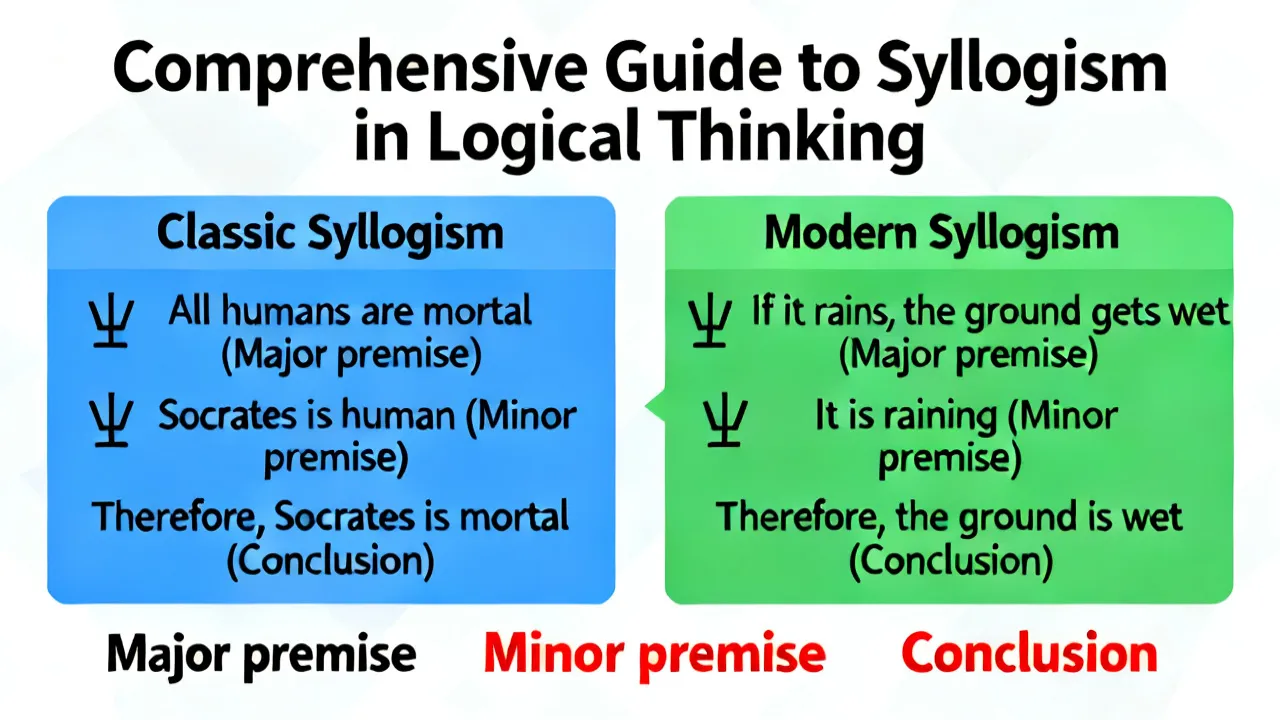
At its core, a silogism comprises three parts: a major premise, a minor premise, and a conclusion. Each of these elements plays a crucial role in forming a logical bridge that leads from a broad statement to a specific conclusion. The structure allows for a systematic approach to reasoning that is straightforward yet potent. For instance, consider the classic example:
- Major Premise: All humans are mortal.
- Minor Premise: Socrates is a human.
- Conclusion: Therefore, Socrates is mortal.
This structured approach not only aids in affirming truths but also assists in the interpretation of complex arguments, ensuring each component aligns to substantiate the final conclusion. To further understand silogism, it is necessary to delve into different forms of syllogistic reasoning, including categorical, conditional, and disjunctive syllogisms.
Types of Silogism
Different types of silogisms provide various means of constructing logical arguments. Understanding these types is crucial in comprehensively analyzing and applying silogistic reasoning across disciplines. Below are some of the most recognized types:
- Categorical Silogism: This is the most common form of silogism, which asserts a relationship between categories. For example:
Major Premise: All mammals are warm-blooded.
Minor Premise: All dogs are mammals.
Conclusion: Therefore, all dogs are warm-blooded. - Conditional Silogism: This form involves premises structured around conditional (if-then) statements. An example would be:
Major Premise: If it rains, then the ground will be wet.
Minor Premise: It is raining.
Conclusion: Therefore, the ground is wet. - Disjunctive Silogism: In this type, one premise presents multiple options, and the conclusion excludes one of those choices. For instance:
Major Premise: Either the cake is chocolate or vanilla.
Minor Premise: The cake is not vanilla.
Conclusion: Therefore, the cake is chocolate.
Applications of Silogism in Modern Contexts
In today's fast-paced environment, the principles of silogism are increasingly applied across various sectors. From jurisprudence to computational logic, its utility in creating algorithms that mimic human reasoning in technologies like AI demonstrates its timeless value. Additionally, in educational settings, teaching silogistic thought encourages students to engage critically, enhancing their problem-solving abilities.
Silogism in Legal Reasoning
In the legal realm, the application of silogistic reasoning is pivotal. Lawyers often present their arguments using syllogistic structures to clearly outline their logic before judges and juries. A common format might include:
Major Premise: All individuals accused of a crime deserve a fair trial.
Minor Premise: John Doe is accused of a crime.
Conclusion: Therefore, John Doe deserves a fair trial.
This clarity provided by silogism helps distill complex legal arguments into understandable propositions, ensuring that essential principles of justice are upheld.
Silogism in Technology
As cognitive technologies advance, silogism plays a crucial role in enhancing artificial intelligence systems. Algorithms that employ logical structures facilitate the development of responsive and adaptive AI, simulating decision-making processes akin to human cognition. For instance, in healthcare, AI can analyze patient data using silogistic reasoning to assist in diagnostic processes:
- Major Premise: All patients who exhibit symptoms A, B, and C have disease X.
- Minor Premise: Patient Y exhibits symptoms A, B, and C.
- Conclusion: Therefore, Patient Y may have disease X.
This logical process enables the systems to anticipate outcomes, substantially enhancing diagnosis accuracy and operational efficiency.
Silogism Versus Other Forms of Logic
Understanding silogism also involves recognizing its distinctions from other logical methodologies, such as inductive reasoning and abduction. Unlike inductive reasoning, which involves deriving generalizations from specific observations, silogistic reasoning moves from universal truths to specific conclusions, offering a hybrid union with deductive reasoning.
| Type of Reasoning | Description | Example |
|---|---|---|
| Silogism | Conclusion derived from two premises - a major and a minor. | All birds have feathers. A sparrow is a bird. Therefore, a sparrow has feathers. |
| Induction | Generalization based on specific instances. | Every swan I have seen is white. Thus, all swans are white. |
| Deduction | Conclusion drawn from general to specific. | All men are mortal. Socrates is a man. Therefore, Socrates is mortal. |
| Abduction | Forming a hypothesis for an observation. | The grass is wet. It probably rained. |
Implementing Silogism in Cognitive Technologies
Cognitive technologies leverage silogism to enhance machine learning and AI systems. By encoding logical structures, AI can anticipate outcomes, simulating decision-making processes akin to human cognition. This capacity allows systems to streamline operations, significantly improving efficiency in fields ranging from healthcare to autonomous vehicles. Moreover, this logical framework is foundational in ethical decision-making algorithms, where AI must weigh consequences and choose accordingly.
Ethical Decision-Making in AI
The incorporation of silogistic reasoning into AI models aimed at ethical decision-making is a burgeoning field. For instance, consider a self-driving car that must make decisions in emergency situations:
- Major Premise: If a collision is unavoidable, the car must choose to protect the greater number of lives.
- Minor Premise: The car has two options: collide with a pedestrian or swerve into a building, risking passenger lives.
- Conclusion: Therefore, swerve into the building to minimize harm to multiple lives.
Algorithms designed around silogistic reasoning allow for clear criteria to inform decision-making in the face of moral quandaries, representing a significant advancement in the pursuit of responsible AI development.
Practical Applications of Silogism in Everyday Life
Beyond the academic and technological realms, silogism can be a powerful tool in everyday problem-solving. It enables individuals to structure their thoughts and arguments logically, leading to clearer decision-making and more effective communication. The ability to apply logical reasoning like silogism can enhance one's capacity to debate issues, evaluate various perspectives, and arrive at informed conclusions.
Silogism in Personal Decision-Making
Individuals can harness the principles of silogism to navigate complex personal decisions. For example, when deciding on financial investments:
- Major Premise: All reliable investments tend to yield returns.
- Minor Premise: Investment A is a reliable investment.
- Conclusion: Therefore, Investment A will likely yield returns.
This logical framework empowers individuals to analyze their options critically and make informed choices inside and outside the financial sphere, promoting better life management.
Silogism in Relationships
Applying silogistic reasoning can also aid individuals in communication and conflict resolution within personal relationships. For instance:
- Major Premise: Healthy relationships are based on open communication.
- Minor Premise: My partner and I often avoid discussing difficult topics.
- Conclusion: Therefore, we need to improve our communication to enhance our relationship.
This application of silogism fosters understanding and provides a pathway for resolving conflicts through structured dialogue and recognition of underlying patterns.
FAQs
Q: Why is silogism important in logical reasoning?
A: Silogism helps establish a clear path from general principles to specific conclusions, ensuring arguments are coherent and sound.
Q: How does silogism benefit AI development?
A: By instilling logical structures within AI systems, silogism enhances decision-making, providing AI with a foundation to predict and respond accurately.
Q: Can silogism be applied in everyday problem-solving?
A: Absolutely! It empowers individuals to dissect problems logically, paving the way for reasoned and structured solutions.
Critiques of Silogism
While silogism has been a cornerstone of logical thought, it is not without its critiques. Some scholars argue that the rigid structure of syllogistic reasoning may oversimplify complex arguments, reducing nuanced discussions to overly simplistic terms. Moreover, the reliance on universally accepted premises can lead to problems if those premises are indeed flawed or contentious. This is particularly pronounced in real-world applications where moral, ethical, and subjective dimensions complicate clear-cut conclusions.
Additionally, while traditional syllogism is valuable in certain contexts, the complexities of modern logic, including fuzzy logic and probabilistic reasoning, have presented new avenues for inquiry. These contemporary frameworks allow for more flexibility in dealing with uncertainty and vagueness, which are often present in human thought and reasoning.
Concluding Thoughts
Silogism stands as a timeless testament to human intellectual progress. Its consistent application across diverse domains underlines its significance in shaping our understanding of logic and argumentation. The structured nature of silogistic reasoning grants clarity and direction to thought processes, making it an invaluable tool for educators, technologists, and individuals alike. For scholars, technologists, and learners, mastering silogism is not merely an academic exercise but a vital tool in navigating the complexities of an evolving world and in creating frameworks for sound reasoning. As we continue to explore the intersection of logic, technology, and human cognition, the principles of silogism will undoubtedly play a fundamental role in defining how we understand and manipulate our realities.