
Understanding Silogism in Philosophy
Silogism is a form of reasoning in which a conclusion is drawn from two given or assumed propositions, known as premises. Developed by Aristotle, this foundational concept in logic forms the basis of deductive reasoning. The exploration of silogism aids in understanding how structured thought and reasoning can lead to sound conclusions, facilitating clear communication and problem-solving in various fields of study.
Diving into Silogism: A Foundational Logical Structure
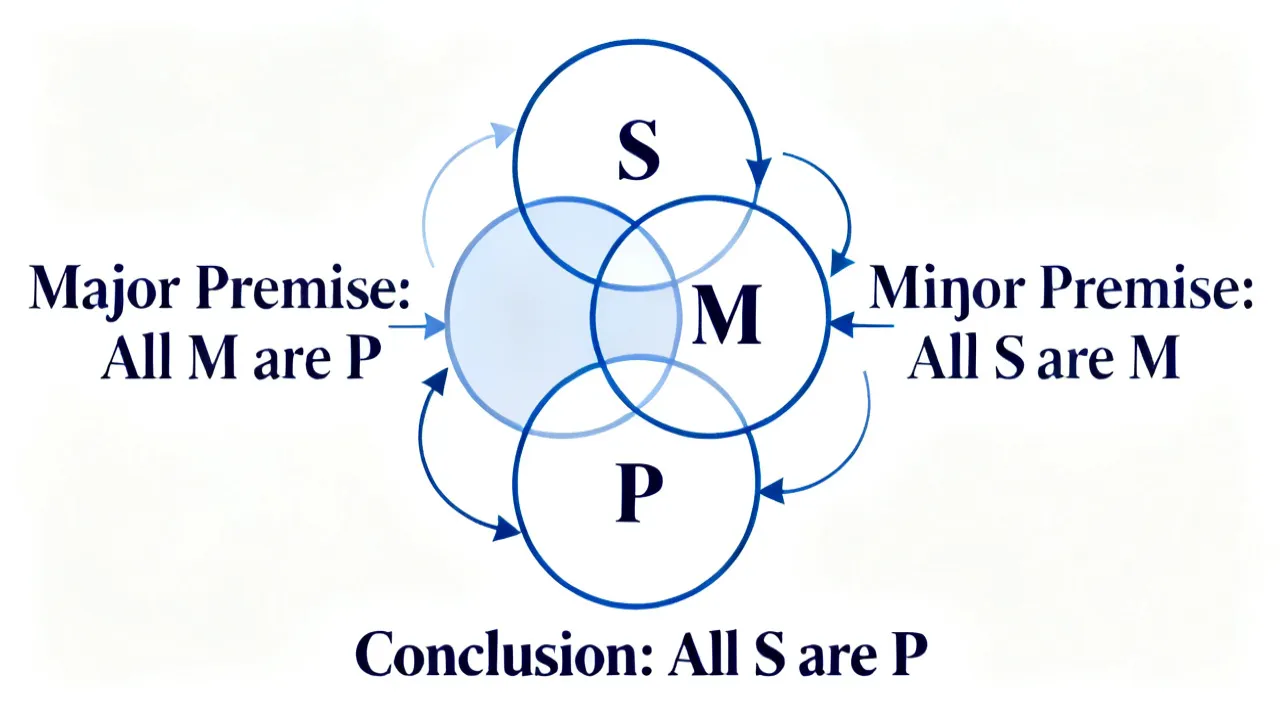
Silogism, as a core component of Aristotle's logical framework, is fundamental to understanding structured reasoning. In philosophy, silogism is used to form conclusions based on the relationship between different premises. This concept not only aids philosophers but also is crucial in various fields requiring logical structuring, such as mathematics, computer science, and artificial intelligence. Derived from the Greek word "syllogismos," it encompasses three parts: a major premise, a minor premise, and a conclusion, which together allow individuals to derive logically sound conclusions based on established truths.
The Anatomy of a Silogism
A classical silogism consists of two premises that lead to a logical conclusion. For example:
- Major Premise: All humans are mortal.
- Minor Premise: Socrates is a human.
- Conclusion: Therefore, Socrates is mortal.
This simple yet profound method of deductive reasoning is crucial to ensuring that conclusions are sound and logically valid. By breaking down arguments into these three components—major premise, minor premise, and conclusion—silogisms allow for a clearer understanding of reasoning processes and their implications.
In further elaboration, a silogism comprises the following components:
- Major Premise: This is the general statement that typically encompasses a wider category and holds the key truth that will connect to the minor premise.
- Minor Premise: This premise introduces a specific instance or example related to the major premise.
- Conclusion: The logical outcome derived from the combination of the major and minor premises, indicating how the specific instance exemplifies the general truth.
The Historical Context and Importance of Silogism
Aristotle, a prominent Greek philosopher, introduced silogism in his treatise "Prior Analytics" around 350 BCE. Aristotle's work represented the first systematic attempt to structure reasoning logically, thus providing a framework that would influence philosophical discourse for centuries. The method became a cornerstone of logic, influencing centuries of philosophical thought and scientific methodology. It was essential in establishing a formal basis for deductive reasoning, which is still central in many areas of study today.
The application of silogism extends beyond pure philosophy into law, computer programming, and artificial intelligence, where clear, logical reasoning is paramount. For instance, in the legal domain, attorneys often rely on silogistic reasoning to construct compelling arguments based on evidence and established laws. Similarly, in programming, logical constructs and conditional statements follow similar patterns to those found in silogisms, thereby enhancing accuracy and efficiency in code execution.
Emphasizing the significance of silogism, many philosophical schools have integrated it into their teachings. The medieval scholastic philosophers heavily utilized silogism in their theological and philosophical arguments, showcasing its versatility and foundational role in Western thought. Moreover, modern philosophical discussions continue to rely on the principles established by Aristotle, reflecting silogism's enduring relevance in logical analysis and critique.
Types of Silogism and Their Applications
Silogism can vary based on its structure and the nature of premises. Common types include:
- Categorical Silogism: Involves statements that assert or deny something about a category. It utilizes universal affirmatives ("All") or negatives ("No").
- Hypothetical Silogism: Concerns "if-then" scenarios and is crucial in hypothesis testing in scientific research, allowing for a conditional logic flow.
- Disjunctive Silogism: Uses an "either-or" statement, frequently used in decision-making processes. It allows for a systematic elimination of options.
Each type plays a pivotal role in advancing critical thinking skills and is utilized in complex problem-solving scenarios across different disciplines. For example, in the medical field, hypothetical silogism can be applied to deduce potential outcomes based on patient symptoms and known medical protocols. Understanding these variations enhances one's ability to articulate arguments effectively and systematically approach problem-solving.
Practical Implications of Silogism in Modern Contexts
Understanding and employing silogism enables individuals to structure arguments logically, recognize fallacies, and enhance their problem-solving capabilities. In education, it is a staple in teaching logical reasoning, underscoring its significance in developing analytical skills. It provides a structured approach to dissecting arguments, enabling students to understand the importance of premise validity and how it affects conclusions.
In business, executives use silogistic reasoning to evaluate strategies and predict outcomes reliably. For instance, making strategic decisions regarding investments often relies on a silogistic approach: if investing in Company A leads to higher returns (major premise), and Company A is showing strong market performance (minor premise), then it is reasonable to conclude that investing in Company A will yield a profit.
Moreover, in fields such as computer science, algorithms often embody silogistic principles. For example, decision trees utilize categorical statements to guide the logical progression of choices, akin to a silogism’s premises leading to a conclusion. This structured reasoning framework assists programmers in developing systematic processes that drive software functionality.
Furthermore, the practice of critical thinking nurtured through understanding silogism enriches personal decision-making. Individuals who grasp this logical framework can better navigate complex choices in everyday life, from making informed purchases to engaging in civic discussions and debates.
Table: Types and Examples of Silogism
| Type | Example | Description |
|---|---|---|
| Categorical | All birds have wings. A robin is a bird. Therefore, a robin has wings. | Argues from a general statement to a particular instance using category. |
| Hypothetical | If it rains, the ground gets wet. It is raining. Therefore, the ground is wet. | Involves conditional statements, essential for hypothetical scenarios. |
| Disjunctive | Either we will travel by car or by train. We are not traveling by train. Therefore, we will travel by car. | Uses an either-or format to lead to a conclusion based on elimination. |
Common Misunderstandings and Misapplications of Silogism
While silogisms serve as powerful tools in logical reasoning, they are often misunderstood or misapplied. Some of the most common mistakes include:
- Faulty premises: If either the major or minor premise is incorrect, the conclusion may be misleading or fallacious. For instance, if someone concludes that "All fish can fly" (major premise) and states "A goldfish is a fish," leading to "Therefore, a goldfish can fly," the conclusion fails due to an incorrect premise.
- Ambiguity in terms: If the terms used in the premises are not clearly defined, it can lead to confusion and incorrect conclusions. A classic example is seen in the statement "All banks are by the water," which can refer to riverbanks or financial institutions. Such ambiguity compromises logical validity.
- Assuming the conclusion without premises: When individuals attempt to jump to conclusions without providing adequate premises, they negate the structure of silogism. For example, asserting "Socrates is mortal" without linking it to a premise about human mortality lacks logical support.
These errors can significantly impact discussions, debates, and critical thinking processes. It is crucial for individuals engaging in logical reasoning to be aware of these pitfalls to construct valid arguments effectively.
FAQs about Silogism
- What is the purpose of silogism?
Silogism is designed to test the validity of arguments, ensuring that conclusions logically follow from premises through deduction. - How is silogism relevant today?
It remains a vital tool in fields requiring rigorous logical analysis, such as law, computer science, and philosophy, providing a logical structure for various arguments. - Can silogism be applied in everyday decision-making?
Yes, understanding silogism helps in making rational decisions by ensuring clarity in reasoning, allowing for structured approaches to common dilemmas. - What are common mistakes with silogisms?
Common mistakes include faulty premises, logical fallacies leading to incorrect conclusions, and ambiguity in terms used.
The Future of Silogism in an Age of Information
As society continues to evolve in the digital age, the relevance of silogism remains strong. With the rise of artificial intelligence and automated reasoning systems, understanding logical frameworks like silogism is increasingly essential. AI programming often hinges on fundamental principles of logic, making it vital for technologists and data scientists to grasp these concepts.
Moreover, in a world filled with information overload and misinformation, the ability to analyze arguments critically becomes even more crucial. Silogism equips individuals with the tools necessary to dissect claims, analyze arguments, and arrive at informed conclusions, thereby fostering a culture of critical thinking.
Educational institutions are increasingly incorporating formal logic and silogistic reasoning into curricula to prepare students for a future where analytical reasoning skills are paramount. By equipping learners with the ability to construct valid arguments and recognize fallacies, educators are enhancing civic engagement and informed discourse among future generations.
Ultimately, silogism is not merely a historical artifact; its principles continue to provide a framework for logical reasoning, empowering individuals to navigate complex landscapes of thought and argumentation effectively.
In sum, silogism remains a cornerstone of logical reasoning and critical thinking, proving indispensable across various aspects of academic inquiry and practical application. Its structure and utilization enable individuals to engage with complex problems, sharpening clarity and precision in both professional and personal contexts. Understanding silogism paves the way for informed discussions, decision-making, and laying the groundwork for further advancements in various fields driven by logic and reasoning.